
AI · Oct 30, 2026 · 8 min read
AI agents are moving beyond IT: 6 lessons for delivering trusted enterprise and healthcare AI
AI creates value when it has reliable context, fits a real workflow, and stays inside controls that match the task. Six delivery lessons from enterprise automation and clinical AI.
By PKT Info Tech
Views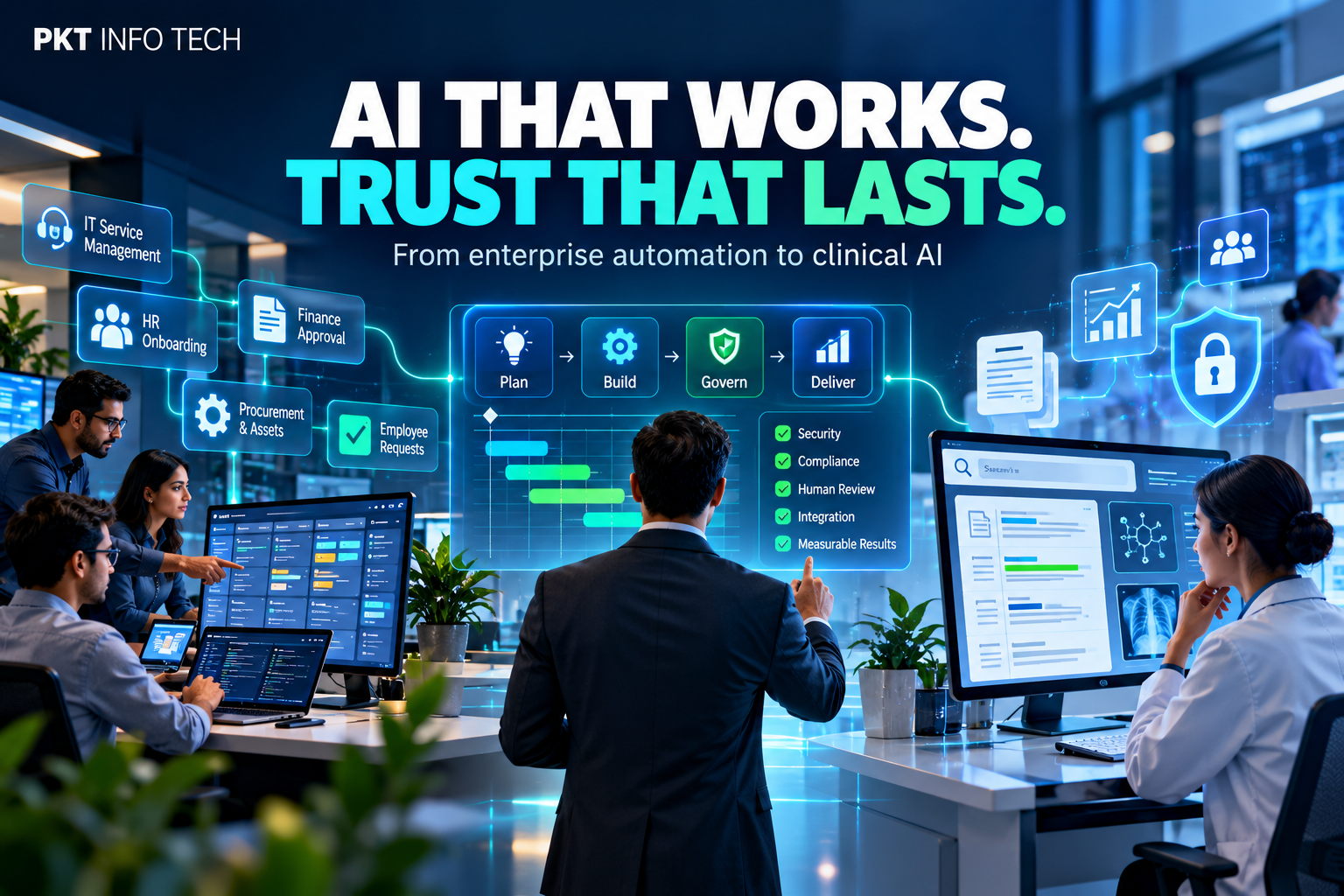
AI is moving from answers into real work
AI is moving from answering questions to participating in real work. That creates a delivery challenge: how can organisations make AI useful inside important workflows without losing control, quality, or accountability?
Two announcements this week show the shift. On 29 October 2026, enterprise automation company Serval announced a $150 million Series C at a $3 billion valuation. Its platform is designed to help employees build AI-assisted workflows across IT, security, HR, finance, and legal, with administrators managing permissions and approvals. On 27 October, clinical AI company Vera Health announced a $28.5 million Series A, bringing total funding to $32 million. Vera says more than 800,000 clinicians across 190 countries use its evidence-focused search platform, which links answers to medical research and makes evidence strength visible.
The industries differ, but the delivery lesson is shared: AI creates value when it has reliable context, fits a real workflow, and operates within controls appropriate to the task. Adoption and product-performance figures are company-reported, not a guarantee of results for every organisation.
1. Start with a business workflow, not an AI demo
Serval focuses on repetitive work such as service-desk requests, onboarding, offboarding, access management, and asset administration. Vera targets a specialised knowledge task: helping clinicians find and assess medical evidence. Both start with a defined job to be done.
For delivery managers, begin with process discovery. Map hand-offs, queues, rekeying, delays, exceptions, and decisions. Then choose one frequent, measurable problem. Instead of asking “Where can we add AI?”, ask “Which task wastes time, causes avoidable errors, or blocks higher-value work?” That produces a clearer scope and business case.
2. Give AI reliable context, and show where answers come from
Enterprise agents need accurate information about users, assets, policies, tickets, approvals, and system states. Clinical AI needs current literature and guidelines, plus a way to distinguish strong evidence from weak evidence.
Vera’s evidence-first approach offers a wider design lesson: a fluent answer is not necessarily a reliable answer. Link important claims to sources, show uncertainty, and flag missing or stale information. In business applications, ground outputs in approved company records and make the data used traceable.
Include data ownership, source quality, access rights, refresh frequency, and exception handling in project scope, not just model selection and prompt design.
3. Match autonomy to risk and keep people accountable
Drafting a routine response is different from granting privileged access, changing payroll data, approving a payment, or influencing a clinical decision. These tasks need different levels of control.
Serval describes administrator-managed guardrails, permission checks, and approvals. Vera positions its evidence as support for clinicians, who retain patient context and professional judgement. The practical rule: the higher the impact, the stronger the review.
Define what AI may suggest, what it may prepare for human approval, and what low-risk actions it may execute within limits. Document prohibited actions, escalation paths, audit logs, rollback procedures, and accountable owners before launch.
4. Integrate with the systems people already use
An isolated assistant can become one more place for employees to check. Operational value comes when AI works with systems of record and existing processes.
Enterprise automation may need identity management, service management, HR, finance, email, asset inventories, and approval tools. Clinical applications may need electronic records, trusted references, identity, consent, and local guidance. Weak integration creates duplicate data, conflicting records, and manual workarounds.
Treat APIs, identity, permissions, data mapping, monitoring, and failure recovery as core delivery work. Test the complete workflow, including outages, rejected requests, duplicate events, and upstream changes, before calling a pilot production-ready.
5. Measure outcomes and guardrails together
Evaluate AI against a baseline, not a headline metric. For IT service workflows, measure resolution time, first-time resolution, backlog age, user satisfaction, and escalations. For clinical evidence workflows, assess time to locate relevant evidence, source traceability, clinician review time, and how clearly uncertainty is represented. Clinical safety and patient outcomes need domain-led evaluation; speed alone is insufficient.
Pair every productivity target with a quality or risk measure. If handling time falls but rework rises, the improvement may be illusory. Agree the baseline, target, data source, owner, review cadence, and stop conditions before the pilot begins.
6. Treat adoption as part of the product
People closest to the work understand exceptions that process diagrams miss. Involve service-desk staff, HR and finance teams, clinicians, security specialists, and operational managers in discovery and testing. Ask them to challenge outputs and identify unsafe edge cases.
Provide role-based training, clear escalation routes, feedback channels, and post-launch monitoring. Assign owners to review failures, manage data or model changes, update rules, and retire automations that no longer fit the process.
A practical 30-day delivery plan
A short pilot is enough to learn whether one workflow is ready for a wider rollout. Expand only when the evidence supports it.
- Days 1–7, Discover: choose one workflow, map it, identify stakeholders and systems, assess data sensitivity, and establish a baseline.
- Days 8–14, Design: define permissions, human checkpoints, integrations, acceptance criteria, and success and safety measures.
- Days 15–23, Pilot: build a limited solution, test normal and failure scenarios, review outputs with users, and verify access controls.
- Days 24–30, Evaluate: compare results with the baseline, document risks, train the operational owner, and make a go or no-go decision.
How PKT Info Tech can help
PKT Info Tech helps organisations turn technology challenges into working business solutions. Our services include custom web and business applications, AI integration, SaaS product development, CRM and ERP solutions, workflow automation, API and cloud integration, application modernisation, quality assurance, and technical delivery consulting.
We start by understanding the process and the business outcome, not by pushing a particular AI tool. From requirements and solution design through development, integration, testing, deployment, and ongoing improvement, the focus is software that fits the way your organisation works.
If your team is considering AI automation, application modernisation, or system integration, start with one process that needs to work better. PKT Info Tech can help assess the opportunity and shape a practical delivery roadmap.
The takeaway
Serval’s enterprise automation strategy and Vera Health’s clinical AI adoption show that the next phase of AI is not simply about generating more content. It is about helping people complete real tasks with reliable context, appropriate controls, and evidence of value.
For project and delivery leaders: start with a workflow, prepare the data, match autonomy to risk, integrate properly, measure quality as well as speed, and invest in adoption. That is how an AI pilot becomes a dependable business capability.
Build with purpose. Deliver with confidence. Measure the impact.
Continue reading






Swipe to continue reading
Want help applying this to your product?
Talk through your software, SaaS, ecommerce or AI requirement with the PKT Info Tech team.